Paper links gravitational wave background to quasar luminosity functions
A new arXiv paper fits gravitational wave background black hole mass functions to quasar luminosity data across redshifts 0.2 to 6.2.
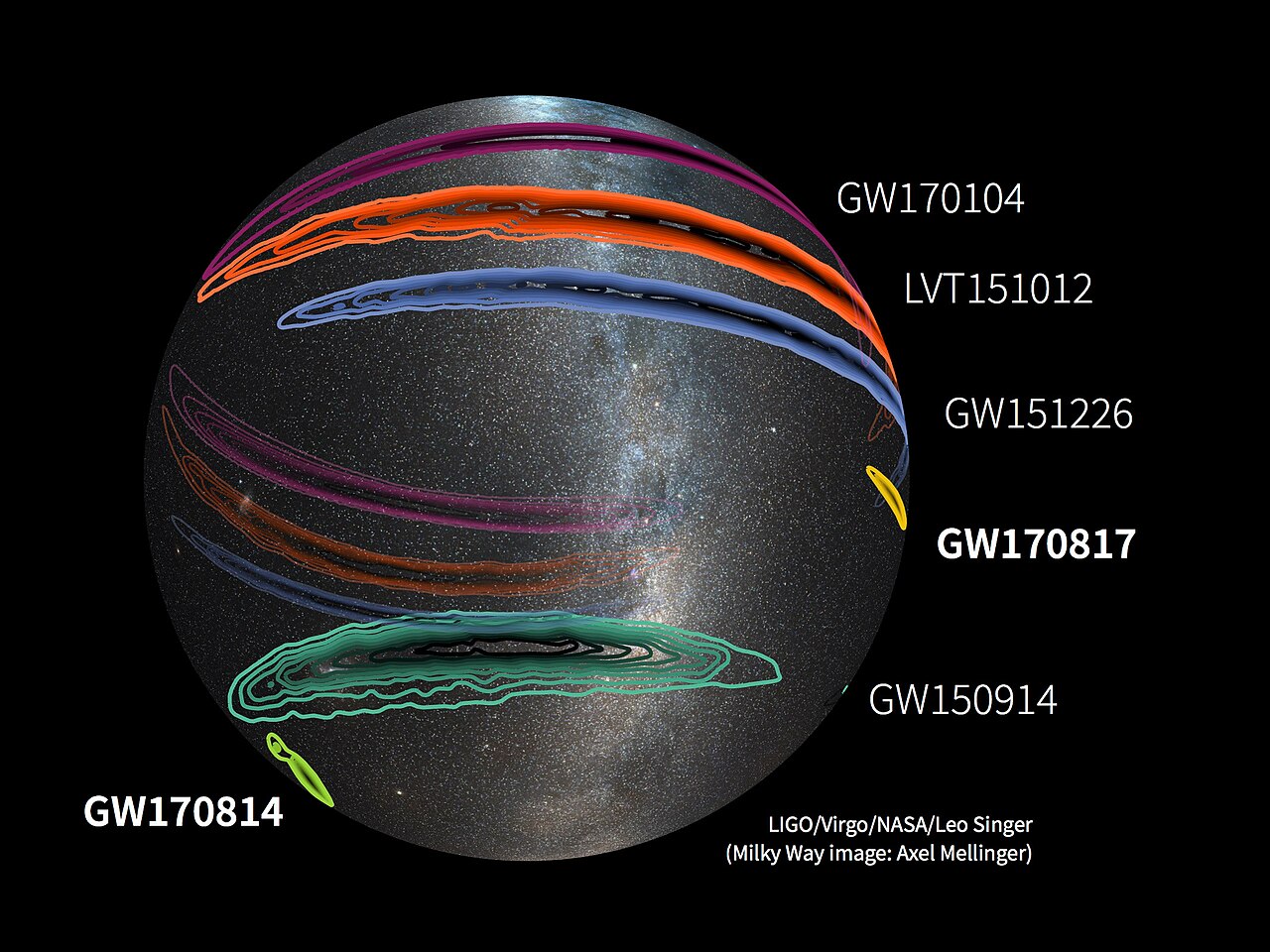
A paper posted to arXiv on 19 October by Cayenne Matt and two co-authors links the nanohertz gravitational wave background to quasar luminosity functions. The authors take posterior black hole mass functions that describe the background and fit them to bolometric quasar luminosity functions between redshifts 0.2 and 6.2. The aim is to constrain the Eddington ratio distribution function.
The authors report that mass functions matching the gravitational wave background reproduce the observed quasar luminosity functions with lower Eddington fractions than a fiducial model. The fiducial model is based on galaxy and local black hole mass scaling relations. The fits do not require significant super-Eddington accretion.
Using a double power-law form, the authors find systematically lower break-points and marginally steeper slopes in the high-Eddington portion of the function. The best-fit luminosity functions also match the high-luminosity end of the data better than the fiducial model. In both models the break-point evolves significantly with redshift and peaks around a redshift of 2.
Sourcearxiv.org